Ghana Seeks to Turn Slavery Reparations Debate into Concrete Action
Edited By: Tendai Zola
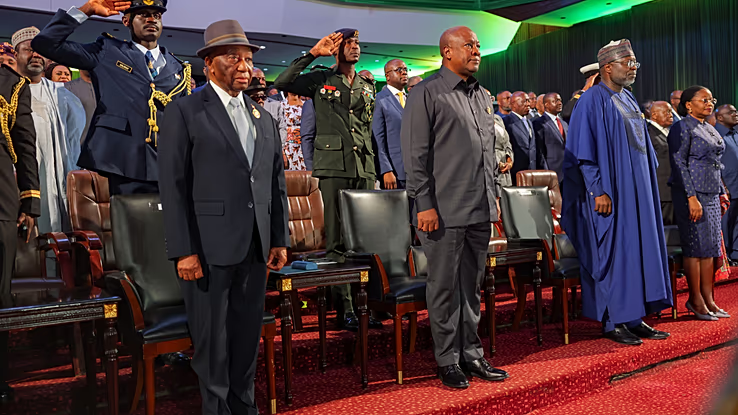
Ghana hosted a landmark international conference on Thursday aimed at transforming growing political support for slavery reparations into tangible commitments toward historical justice.
The gathering brought together leaders and representatives from Africa and the Caribbean, following the adoption by the United Nations in March of a historic resolution describing the transatlantic slave trade as “the gravest crime against humanity.”
According to Ghana’s Foreign Minister Samuel Okudzeto Ablakwa, the campaign for reparatory justice has gained unprecedented momentum since the resolution was adopted. Although the text is not legally binding, it goes beyond symbolic recognition by calling on countries involved in the slave trade to engage in restitution and compensation.
“We won the battle against slavery, we won the battle against colonialism, we won the battle against apartheid, and we are confident that we shall win the battle against reparatory injustice,” Ablakwa told participants.
The resolution, championed by Ghanaian President John Dramani Mahama, received the backing of 123 UN member states, making it the strongest international endorsement to date of calls for reparations linked to slavery and colonial exploitation.
Recent developments have further strengthened the debate. French President Emmanuel Macron has expressed support for the symbolic repeal of historical decrees that regulated slavery in French colonies and acknowledged that the question of reparations must be addressed, while cautioning against creating unrealistic expectations. Addressing the conference by video link, Macron stated that history should not be reduced to a purely financial issue.
Last month, Pope Leo XIV also issued an apology for the Catholic Church’s centuries-long failure to condemn slavery, describing it as “a wound in Christian memory.”
From Historical Trauma to Restorative Justice
Once a major hub of the transatlantic slave trade, Ghana is increasingly positioning itself as a center for healing, reconciliation, and reparatory justice.
Over recent years, the country has strengthened ties with the African diaspora and granted Ghanaian citizenship to more than 1,000 descendants of Africans displaced through slavery.
President Mahama announced the creation of three working bodies tasked with developing practical pathways toward reparatory justice. The first will be an advisory panel composed of heads of state, the second a group of experts focusing on restitution mechanisms, and the third a legal panel examining the international dimensions of reparations.
“The question before us is not whether history can be changed—it cannot—but whether we have the courage to confront it honestly and the determination to turn recognition into meaningful action,” Mahama said.
Calls for Action Beyond Symbolism
The three-day conference featured prominent figures including the leaders of Barbados, Sierra Leone, Senegal, Namibia, and Liberia, as well as Nigerian Nobel Prize-winning author and human rights advocate Wole Soyinka.
Soyinka stressed that reparatory justice must extend beyond symbolic gestures.
“It is not merely about apology or compensation; it is about the rehumanisation of memory and the restoration of values distorted by centuries of dehumanisation,” he said.
At the same time, he warned against focusing exclusively on historical injustices while ignoring contemporary human rights abuses, citing the kidnapping of schoolchildren for ransom in parts of Africa as an example of ongoing violations that also require urgent attention.
Conference participant Mariam Abdoulaye of Burkina Faso said many Africans expect reparations to include structured compensation funds directed toward governments or affected communities, debt relief or restructuring, and the return of cultural artifacts removed during the colonial era.
As international support continues to grow, Ghana hopes the conversation on reparations will evolve from moral recognition into concrete political, legal, and economic measures aimed at addressing the enduring consequences of slavery and colonialism.